Buying A Home Checklist: A Practical Guide from Budget to Exchange
Based on official UK sources:MoneyHelper: Mortgage affordability guidance, HM Land Registry sold-price service, GOV.UK: Environment Agency flood-risk service, GOV.UK: Official EPC register, GOV.UK’s Stamp Duty Land Tax guidance and GOV.WALES: Land Transaction Tax.
A useful buying a home checklist takes you from “Can I afford this?” to “Am I ready to exchange?” in a deliberate order: set a whole-purchase budget, research areas and properties, view with a plan, make an offer you can support, then work through finance, legal checks and the survey before committing. It helps first-time buyers and home movers spot unanswered questions early, when there is still time to investigate or change course.
Keep one record for each property: the evidence you have, what is still unknown, who will check it and by when. The goal is not to eliminate every uncertainty; it is to avoid treating an assumption as a fact or letting a deadline make a decision for you.
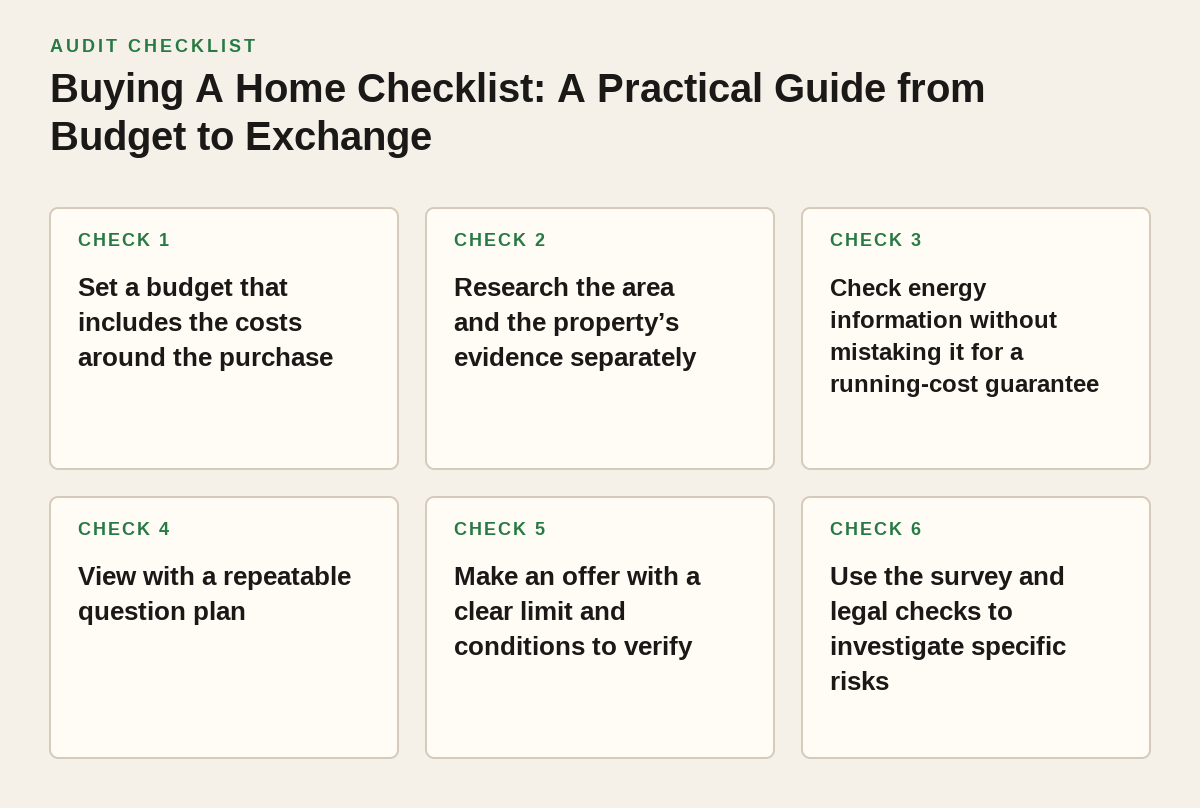
1. Set a budget that includes the costs around the purchase
When it applies: before you book viewings or decide what asking prices to target. A mortgage figure is not the same as a comfortable purchase budget: you also need to consider your deposit, transaction costs, moving expenses and the monthly cost of running the home.
Why it works: separating the purchase price from the money you need to complete makes trade-offs visible. If one property uses nearly all your available funds, you may have little room for fees, urgent repairs or a change in circumstances. A lender’s maximum offer is not automatically the right amount for your household.
Build two budget views
- Cash to complete: deposit, legal and other transaction costs, moving costs, and any immediate work you already expect.
- Monthly commitment: mortgage payments alongside council tax, utilities, insurance, travel and regular maintenance.
- Resilience: money you choose to keep back rather than use to increase your offer.
For example, if a buyer is comparing a smaller home near work with a larger home farther away, the second property’s price alone does not show the full trade-off. Add likely commuting costs and energy use to the comparison, then decide whether the space is worth the ongoing expense.
MoneyHelper’s mortgage affordability guidance can help structure an estimate, but it cannot confirm what a lender will offer or what is affordable for your particular household. Check any mortgage figures with a lender or suitably qualified adviser, and verify taxes and purchase costs for the relevant nation and circumstances.
Common failure: setting a ceiling based on the maximum mortgage estimate, then treating every other cost as a later problem. Instead, write down a purchase-price limit and a separate cash reserve before viewing. If you want a starting estimate, you can check what you can afford; use it as planning support, not a mortgage offer.
2. Research the area and the property’s evidence separately
When it applies: when a listing looks promising, and again before you make an offer. Marketing copy can describe a property, but it does not establish what similar homes sold for, whether the location suits your routine or what risks need checking.
Why it works: splitting the research into “the home” and “the place” prevents a strong impression in one area from hiding a poor fit in another. It also gives you evidence to support a negotiation rather than relying on a vague sense that the asking price is high.
Make a short evidence file
- Record the asking price, property type, size and any details that affect comparability.
- Look up relevant completed sales using the HM Land Registry sold-price service. Treat nearby sales as context, not a valuation: differences in condition, size, tenure and timing can matter.
- Check your actual journey to work, shops or other regular destinations at the times you would travel.
- Use official tools to investigate specific concerns, such as the Environment Agency flood-risk service. A screening result is a prompt for further questions, not a full property assessment.
For an illustrative comparison, shortlist two similar homes and note why each sale you use is comparable or not. If the evidence is thin, mark the price view “uncertain” rather than stretching a single sale into a confident conclusion. Research schools or environmental data against the household’s actual needs and check the relevant source directly; a map or rating alone cannot describe every local condition.
Common failure: comparing properties by postcode or asking price alone. Add a “what could change my view?” note: for example, a different tenure, a short lease, an unverified extension or a location-specific risk. That turns research into a list of questions for the agent, solicitor or surveyor.
3. Check energy information without mistaking it for a running-cost guarantee
When it applies: when comparing homes with different heating systems, insulation or EPC ratings, or when you are budgeting for likely improvements. Energy performance can affect comfort and bills, but the rating is not a promise of what you will pay.
Why it works: checking the underlying certificate gives you a consistent starting point for questions about heating, insulation and recommended measures. The official EPC register lets you look for a certificate by property details. Check that the address and property match the listing, and note the certificate date and recommendations.
Use the information as a prompt, not a quote. Actual energy use depends on the occupants, heating habits, tariffs, weather and the home’s condition. If a suggested improvement would influence your offer, ask what work has already been done and whether there is evidence such as installation records. For a material concern, get an appropriate professional view rather than assuming a recommendation is straightforward or cost-effective.
Common failure: turning an EPC estimate into a precise monthly bill or assuming a proposed upgrade will achieve a particular rating. In your comparison sheet, record the EPC information separately from your own estimated running costs and flag any uncertainty. This matters especially when a less expensive home may need work you cannot fund immediately.
4. View with a repeatable question plan
When it applies: at every viewing, including a second visit. A checklist helps you compare homes consistently and notice issues that are easy to overlook when you are focused on layout or imagining where furniture will go.
Why it works: observations are more useful when paired with a question and a way to verify the answer. A viewing is not a building survey, and sellers or agents may not know the full history; record what you see, what you are told and what remains unconfirmed as separate things.
Use three passes through the property
- Fit: test the layout against your daily routines, storage needs, access requirements and likely changes in household needs.
- Condition: look for visible signs worth asking about, such as staining, cracking, condensation, uneven floors or recently redecorated patches.
- Evidence: ask about alterations, heating, roof or window work, boundaries, parking and what fixtures are included. Write down answers rather than relying on memory.
For example, if a room has a fresh patch of paint near a ceiling, do not conclude that it hides a leak. Ask whether there has been a leak, when it occurred and what repair was completed; then tell your surveyor what you observed. If an answer is uncertain, record it as uncertain.
Common failure: using the viewing to make a technical diagnosis. The practical aim is to gather clues and identify follow-up checks, not to decide whether a crack is harmless. A property-specific viewing checklist, such as questions to ask about alterations or damp, helps turn observations into a useful brief for your surveyor.
5. Make an offer with a clear limit and conditions to verify
When it applies: once you have decided the property is a serious candidate and have enough information to set a limit. Your offer should reflect your budget and evidence, not just the seller’s asking price or pressure to move quickly.
Why it works: deciding your maximum in advance makes it easier to respond calmly if the seller asks for more. It also separates your willingness to pay from unresolved questions that could affect the property’s value or suitability.
Prepare before contacting the agent
- Write down your offer, your evidence for it and your private maximum.
- Clarify what is included, such as appliances or other items, and ask the agent to confirm the seller’s position.
- Explain your position accurately, including whether you need to sell another property or have finance still to arrange.
- Keep a record of the offer and any response. Ask the agent to confirm important details in writing.
For example, if comparable sales suggest a lower figure but the home has a feature you value, decide whether that feature justifies moving your offer—and by how much—before negotiating. If new information appears, such as an unresolved alteration or an unexpected repair, pause to assess it rather than automatically increasing your bid to stay competitive.
Common failure: treating an accepted offer as proof that the property is yours or that all checks are complete. Keep the survey, legal enquiries and mortgage process moving, and do not spend money on work or make commitments on the assumption that the purchase will complete. The legal position and process can depend on the circumstances; ask your conveyancer what each stage means for your transaction.
6. Use the survey and legal checks to investigate specific risks
When it applies: after your offer is accepted and before you commit to exchange. The survey and conveyancing process answer different questions: a survey assesses the property’s condition, while your conveyancer handles legal matters and enquiries. Neither should be treated as a substitute for the other.
Why it works: targeted follow-up is more useful than simply collecting reports. A finding may be routine maintenance, a reason to seek specialist advice, a negotiation point or a reason to reconsider. The action depends on the finding, its implications and your own tolerance for cost and uncertainty.
The Royal Institution of Chartered Surveyors explains the purpose and scope of its home survey options. Ask the surveyor which option fits the property and your concerns. Tell them about anything you noticed at the viewing, and ask how they will handle areas they cannot inspect. A survey has limits; it does not guarantee that every defect will be found.
Turn findings into decisions
- List each issue in plain language and note the report section or legal enquiry it relates to.
- Separate urgent safety or structural concerns from planned maintenance and observations needing more investigation.
- Ask the surveyor, solicitor or a relevant specialist the question that matches their role.
- Decide whether the answer changes your budget, offer, timing or willingness to proceed.
For instance, if a report recommends further investigation of a roof concern, do not assume a worst-case repair cost—or ignore the recommendation because there is no visible leak. Ask what further inspection is appropriate, who should carry it out and whether the result could affect your decision. You can review your home survey to help understand report wording, while directing technical or legal questions to the relevant professional.
Common failure: leaving every question until the end, when there may be little time to obtain a specialist view. Keep an open-issues list with an owner and next action. Do not treat an unanswered enquiry as a reassuring answer.
7. Prioritise open questions by their effect on the decision
When it applies: whenever several checks are outstanding and you need to decide what to chase first. A list ordered by arrival date is less useful than one ordered by the possible consequence of the answer.
Why it works: some unknowns could change whether you buy at all; others affect only a later maintenance plan. A simple framework helps you use limited time on the questions most likely to change your decision. The categories below are a starting policy, not a universal benchmark.
| Priority | Question type | Example next step | Decision to revisit |
|---|---|---|---|
| High | Could affect safety, major cost, legal ownership or whether the home meets a core need | Ask the relevant professional for a specific answer or further investigation | Proceed, renegotiate, pause or withdraw |
| Medium | Could change the budget or require planned work, but may not prevent purchase | Obtain a clearer scope, cost estimate or document | Adjust your reserve or offer assumptions |
| Lower | Preference or maintenance question that does not currently change the purchase decision | Record it for later review or ownership planning | Keep it under review without delaying critical checks |
For each open item, write: what is unknown, what evidence would answer it, who will obtain that evidence, and what you will do if the answer is adverse. For example, “unclear boundary responsibility” is not an action; “ask the conveyancer to check the title documents and explain the boundary obligations” is. If nobody can answer a question conclusively, record the remaining uncertainty and decide whether you can accept it.
Common failure: assigning high priority to whichever email arrived most recently. Revisit the list when new evidence arrives, and escalate an item if it starts affecting your budget, legal position or ability to use the property as intended.
8. Work through the final checks in order before exchange
When it applies: when your mortgage application, survey and legal work are progressing and you are approaching a decision to commit. The sequence matters: exchange is a major commitment, so do not treat it as an administrative milestone to reach while important questions remain unresolved.
Why it works: a final readiness check brings together the separate strands of the purchase. Tax and transaction rules depend on where the property is and on the buyer’s circumstances, so confirm them against current official guidance and your conveyancer’s advice. For example, GOV.UK’s Stamp Duty Land Tax guidance applies to England and Northern Ireland; Wales has a separate Land Transaction Tax system.
Before authorising exchange, ask your conveyancer to explain what remains outstanding and confirm that you understand the commitment. Check that your mortgage arrangements, funds, agreed inclusions, survey follow-ups and any conditions you care about have been addressed. If something material is still unknown, ask whether exchange should wait and what the consequences of waiting would be.
Common failure: assuming that “almost finished” means every important detail has been checked. Keep a written list of final confirmations and do not rely on an agent’s reassurance as a substitute for legal advice on the transaction.
Implementation plan: use the checklist as a sequence, not a scorecard
- Set your limits. Write down your price ceiling, cash reserve and monthly-cost assumptions before arranging viewings.
- Compare candidates. Keep one evidence file per property, including relevant sales, area checks, energy information and unresolved questions.
- View and record. Use the same question plan each time; distinguish what you observed from what someone told you.
- Offer deliberately. Set your figure and private maximum from your budget and evidence, then record the response and any conditions to verify.
- Investigate before committing. Use the survey and conveyancing process to answer property and legal questions, and rank open issues by how much their answers could change your decision.
- Confirm readiness. Before exchange, ask your conveyancer what remains outstanding and make an explicit decision about any uncertainty you are choosing to accept.
HeyKettle provides free home-buying tools for affordability, property and area comparisons, energy information, and plain-English explanations of survey documents. Explore HeyKettle if those tools would help you organise your research; confirm property-specific, mortgage and legal decisions with the appropriate professionals.
Authored with NotFair SEO