Mortgage Affordability: How to Work Out What You Can Borrow
Based on official UK sources:MoneyHelper: How much you can borrow, FCA: MCOB 11.6 requirements, MoneyHelper: Guide to buying and moving costs, GOV.UK SDLT residential property rates, GOV.WALES: LTT rates and bands and GOV.UK energy performance certificate service.
Mortgage affordability is assessed by looking at your income, regular spending, debts and circumstances to judge whether repayments are manageable; it is not simply a salary multiplied by a standard figure. To work out a practical home-buying budget, estimate what a lender might offer, add the deposit you can use, then subtract purchase and moving costs while checking that the monthly payment leaves enough for bills and financial surprises.
Separate a lender’s borrowing estimate from your own budget
A lender’s affordability assessment answers whether it is prepared to lend you a certain amount under its criteria. Your personal budget answers whether you want to carry the resulting payments alongside your other costs. Those amounts may differ: an estimate is a starting point for planning, not a recommendation to borrow the maximum.
There is no single income multiple that reliably tells every buyer what they can borrow. Lenders assess income and outgoings, and their decisions can vary with the application and lender criteria. MoneyHelper’s guide to how much you can borrow explains why an online estimate is a guide rather than a guaranteed offer.
Keep these three figures separate when you start viewing homes:
- Indicative borrowing: an early estimate based on the information you enter.
- Mortgage offer: the amount a lender agrees to lend after assessing your application and the property.
- Your spending limit: the price and monthly payment you choose after allowing for costs, savings and financial resilience.
For a first-time buyer, a larger deposit can increase the funds available towards a purchase, but it does not remove ongoing mortgage payments or household costs. For a home mover, sale proceeds or equity may contribute to the next deposit, but existing borrowing, transaction costs and the timing of a sale can affect the amount actually available. In either case, base the decision on money you can commit without exhausting your buffer, not just the most optimistic estimate.
You can use HeyKettle to check what you can afford as one part of this early planning. Compare the result with your own monthly budget before treating any property price as realistic.
Understand what lenders assess
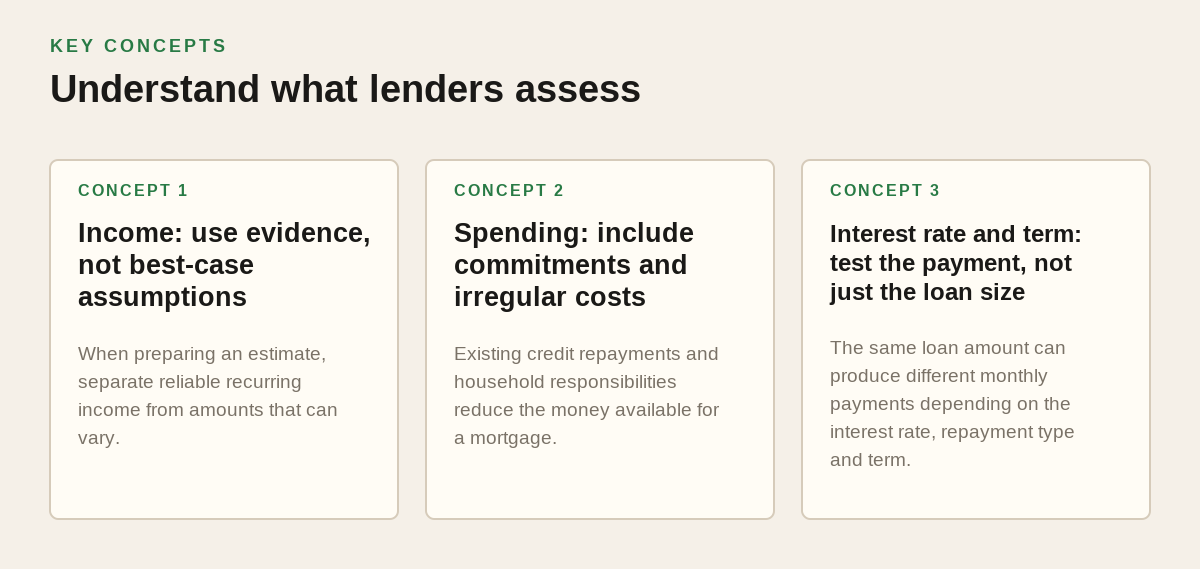
Lenders consider whether a mortgage is likely to be affordable over its term, not just whether you can meet the first payment. The Financial Conduct Authority’s responsible-lending rules set out how firms assess affordability using evidence about income and committed and essential spending, and how they consider potential changes in interest rates where relevant. See the FCA’s MCOB 11.6 requirements; individual lenders apply their own processes within the regulatory framework.
Income: use evidence, not best-case assumptions
When preparing an estimate, separate reliable recurring income from amounts that can vary. An employed applicant may be asked for records such as payslips and bank statements. A self-employed applicant may need to provide accounts, tax calculations or other evidence. Lenders can differ in how they assess variable income, so check what documentation the lender or mortgage adviser requires rather than assuming every payment will count in full.
Bonuses, overtime and commission can make a good month look more representative than it is. For your own budget, ask whether the mortgage payment would still work if an irregular payment fell or stopped. If two incomes support the household, consider how a temporary change to one income would affect your costs. This is a stress test for your own plan, not a forecast that a particular event will happen.
Spending: include commitments and irregular costs
Existing credit repayments and household responsibilities reduce the money available for a mortgage. A budget that omits annual or occasional costs can overstate what appears to be spare income in an ordinary month. Use recent statements and records to list what you spend, including expenses that do not arrive monthly.
- Loan, credit-card and car-finance payments.
- Childcare, maintenance payments and other ongoing responsibilities.
- Utilities, council tax, insurance, travel and food.
- Annual or occasional costs, including repairs and replacing essential items.
Do not assume that paying off a debt just before applying will automatically increase your borrowing. It may affect the savings available for your deposit, and a lender assesses the application as a whole. If you are weighing a specific repayment against keeping cash available, ask the lender or a qualified mortgage adviser how that commitment may be treated.
Interest rate and term: test the payment, not just the loan size
The same loan amount can produce different monthly payments depending on the interest rate, repayment type and term. A longer term generally spreads repayments over more time, but may mean paying interest for longer; a shorter term can raise the monthly payment. A calculator showing one payment at one rate cannot tell you that a lender will approve the loan or that the payment will stay unchanged.
Compare the expected payment with a higher-payment scenario and identify what you would change if costs rose. The purpose is not to predict future rates. It is to check whether there is room in the household budget to absorb a change without relying on more credit or spending all your savings.
Turn borrowing and deposit into a property budget
A borrowing estimate is not the same as a maximum property price. A useful starting calculation is: property budget = borrowing you can support + deposit available − costs you need to pay from your funds. The subtraction matters: conveyancing, tax, moving and immediate property expenses can all compete with the cash you had planned to use as a deposit.
For example, a buyer with an indicative loan and a deposit should not automatically treat their combined value as a bid limit. First, estimate costs for the specific transaction, decide how much savings to keep back, and check the likely mortgage payment against the household budget. This is a method for organising the figures, not a prediction of a buyer’s loan, purchase costs or suitable reserve.
Build a cost list that distinguishes estimates from confirmed amounts:
- Purchase tax that may apply in the nation where the property is located and under the buyer’s circumstances.
- Conveyancing, searches, valuation or survey costs, and any lender-related charges.
- Moving costs and immediate work or purchases needed after completion.
- Mortgage payments and ongoing costs such as buildings insurance, council tax and energy.
Some costs depend on the property or transaction; others depend on the buyer. MoneyHelper’s guide to buying and moving costs is a checklist, not a quote for your purchase. Get relevant estimates and confirm tax treatment before committing funds you may need for the transaction.
Check the property tax for its location
The UK does not have one uniform property purchase tax. The applicable system depends on where the property is, and the amount can also depend on the price and buyer circumstances. Check the rules for the property’s location rather than carrying an estimate from another nation into your budget.
- England and Northern Ireland: Stamp Duty Land Tax (SDLT) may apply to residential purchases. Check the current rules and rates on the GOV.UK SDLT residential property rates page.
- Wales: Land Transaction Tax (LTT) applies to relevant property transactions. The Welsh Government publishes LTT rates and bands.
- Scotland: Land and Buildings Transaction Tax (LBTT) applies to relevant property transactions. Revenue Scotland’s LBTT guidance explains the tax and provides information about rates and reliefs.
These official pages are starting points, not a substitute for checking your own transaction. A second property, buyer circumstances or a transaction-specific relief may affect the calculation. Include an estimate in your budget before deciding how much of your savings to use as a deposit; if the tax position is unclear, ask your conveyancer or an appropriate tax professional to confirm it.
Compare the running costs and condition of homes
Two homes with similar asking prices can leave different amounts of room in your budget after purchase. Mortgage payments are only one part of the comparison: council tax, energy, insurance, maintenance and immediate repairs may also matter. An asking price does not tell you what a home will cost to heat or what work a survey may identify.
For each property, record what you know and what still needs checking. An Energy Performance Certificate (EPC) gives information about a property’s recorded energy rating, but it does not guarantee your future bills. Household behaviour, energy prices and the home’s condition also affect actual use. You can search for a certificate using the official GOV.UK energy performance certificate service.
Use a consistent comparison rather than letting the headline price decide:
- A lower-priced property with significant urgent repairs may require more cash soon after completion.
- A weaker energy rating is a reason to investigate likely running costs and possible improvements, not to assume a particular bill.
- A home with a higher mortgage payment might still fit your chosen budget if other costs are lower; compare evidence for both.
- A survey finding may change your repair allowance or decision to proceed. Ask the surveyor or conveyancer to clarify points you do not understand.
Keep uncertain items visible. If you do not yet know the likely cost of a repair or the significance of a survey finding, record the question and get the relevant information before relying on a best-case assumption. Homebuyers reviewing a report can review your home survey and use the findings to identify points to discuss with a surveyor or conveyancer.
Set a limit you can support before making an offer
Choose a maximum monthly payment and a level of savings you want to retain after the purchase. Those are personal limits, not lender rules. Then check the shortlisted property against both your expected budget and a less comfortable but plausible situation, such as higher household bills or a temporary reduction in income. If the purchase only works when every estimate is favourable, lower the price range or investigate the uncertain costs before proceeding.
To make the estimate usable, work through these steps in order:
- Gather income and spending information, including debts and costs that do not occur every month.
- Get an initial borrowing estimate, then confirm application requirements with a lender or mortgage adviser.
- Set your own monthly payment limit and decide how much savings to keep available.
- Estimate purchase tax and other costs using the rules for the property’s location.
- Compare homes by likely payment, running costs, condition and unanswered questions.
A lender can revise its decision after reviewing your documents, commitments and the property, so do not treat an online estimate as a mortgage offer. The practical aim is to find a property price that fits both the likely borrowing and your own budget without using every available pound of savings. HeyKettle’s HeyKettle can help you assess affordability and compare property information as you narrow your shortlist.
Authored with NotFair SEO